PHOTO
A Short History of the Riverina Wheat Industry written by June Sutherland for the NSW Heritage Office under contract to the Museum of the Riverina in March 1999.
The Narrandera Argus has selected some extracts from the book.
The growth of wheat-growing in the eastern Riverina brought not only farmers but businesses associated with maintaining a healthy farming culture. Churches and schools were needed, doctors and hotels. All this brought with it the good and the bad.
The Riverina in its broadest sense is the land bounded by the Lachlan, Murrumbidgee and Murray rivers: the Riverine slopes and plains.
The Eastern Riverina could most probably be said to be bounded partly by the route taken by Hume and Hovell from Yass to Albury. The mountains give way to the South Western slopes, the hill country with only occasional stretches of flat land, and then to the more open landscape which in its turn becomes extensive plains with few notable high points.
The area is divided into north and south by the watershed between the Murray and the Murrumbidgee Rivers. The Western Slopes are divided from what is called the Central West by a line running just north of Narrandera and Cootamundra and taking in Temora.
Soils in the eastern Riverina were mostly good textured red loams with sandy loams on a clay subsoil. Gray heavy soils and sandy mallee lie in the western part. Black soils were found in the south-west of the region.
The region was watered by the three rivers as well as creeks and billabongs. The backcountry relies on wells and rainfall storage. The rainfall varies across the region from 12-22 inches.
WHEAT GROWING BEFORE 1890
The first grain used by the new European settlers in NSW was that grown at Farm Cove on what was soon recognised as inhospitable soil, to a great depth being nothing but black sand.
Governor Arthur Phillip had not been provided with any of the real necessities of farming in the way of tools, the British suppliers including poorly made hoes and axes. There were no ploughs until 1803.
There were in the colony only a few who understood farming: the Rev Richard Johnson, Edward Dods, the Governor’s servant, and James Ruse, who had been transported for burglary.
In late 1789 the Governor sent Dods to establish Rose Hill (later Parramatta) as a government farm of about 200 acres; James Ruse too was granted 30 acres there, as an experiment to see if a farm of that size could sustain a man and his family in self-sufficiency;
James Ruse had been a farmer in his native Cornwall before he was transported for burglary and Tench's interview recorded the farming methods with which Ruse was familiar and which most settlers in the colony continued to practise in greater or lesser degree well into the 19th century.
The earliest named varieties of wheat which were sown appear to have been English, such as Red Lammas, introduced by an officer of the garrison in Governor King's day. Others such as White Lammas, ripening in England at Lammastide, and creeping wheat, were the main varieties used in 1828.
There was no visible differentiation in the seeds of the varieties being used and with the broadcast sowing of seed so later the crop ripened unevenly and a great deal of grain was lost into the ground to the benefit of mice and other hungry creatures.
The history of farming and farmers in New South Wales did not alter in any great degree until the end of the 19th century. The same faults in practice noted in the early days of the settlement were still subjects of comment at the end of the century and into the 20th century.
From the early days of the colony, by regulation, it was laid down that each convict must receive a basic allowance of grain and meat each week. This was supplied from the Government store for those convicts on public works.
Those masters who had assigned convicts working for them could supply the grain and meat from their own land. After 1815 and the end of the Napoleonic Wars, almost half the convicts were clothed and fed by the Commissariat, provisioned with ample supplies of British funds, so farmers and graziers found there a profitable market for their produce.
For some colonists, more than others, it was a goldmine worth taking the trouble to practise agriculture: John Palmer, in charge of the Commissariat for twenty years had more land under crop than anyone else in the colony; the Reverend Samuel Marsden made an income from his grain, which would have well supplemented his stipend, and without a doubt have financed his missionary efforts in the South Seas.
When there was a good harvest and a glut, the Commissariat store closed and the farmers were forced to sell to speculators with access to storage. When the harvest failed by flood, disease or drought the prices soared, but the small farmers gained nothing.
Many were forced by debt to sell their farms, enabling those with capital to aggregate their existing properties, leaving the erstwhile to find other work or remain as tenants on what had formerly been theirs. Other bad seasons could follow and, like Mary Ann Tyler's parents, unable to pay the rent, had to move.
There were others who considered farming too arduous and labour intensive, preferring the running of stock.
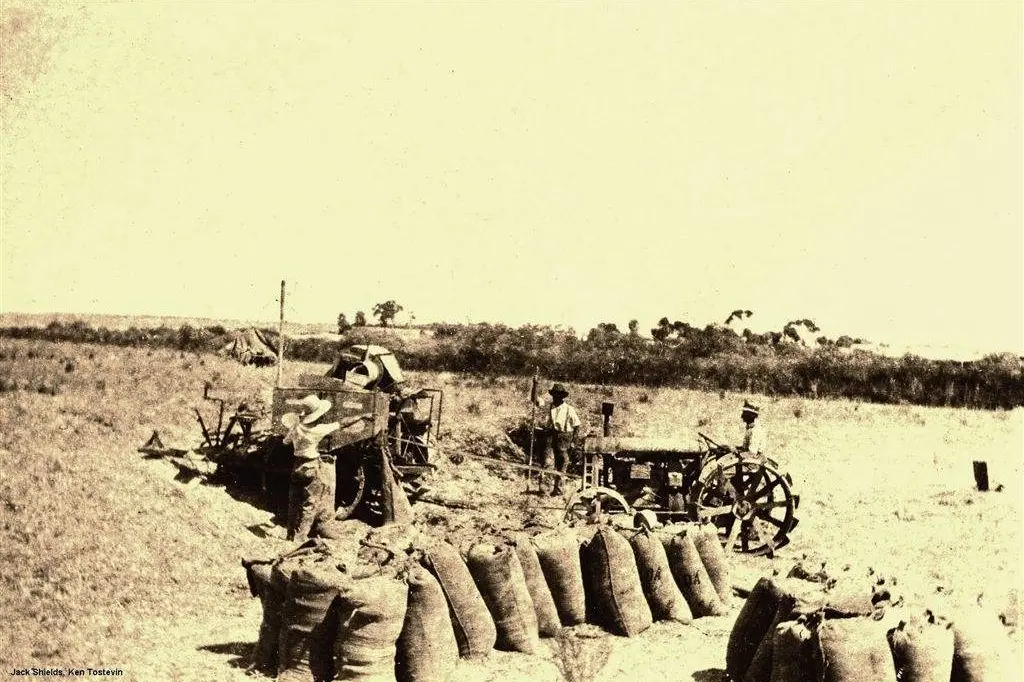
After 1825 there was a lack of labour which hampered the larger wheat growers but favoured small wheat farms where the family were the labour force. In most people's eyes at that time 30 acres was considered reasonably large. The lack of mechanisation meant that farm operations were governed by the speed at which the work in the field could be done.
Of the two tools used in harvesting for the majority for most of the 19th century, the sickle and the scythe, many chose the sickle. Although it was smaller and did not cut such a wide swathe, it was light enough to have been used in the old country by both men and women. However, in Australia, only men used it.
William Macarthur, recording in 1837, said that 31 acres of wheat, at Camden, took seven men 14 days to complete the harvest. There was however a steady expansion of the wheat acreage and by 1845, 10,000 acres of wheat was under wheat crop on the coast and 3600 acres were under crop on the South West Slopes, in the main cultivated by the tenant farmers of the squatters.
The extent of wheat planting increased, 10 000 acres by 1860 and 30,000in 1870. It was said that successful wheat growing by station owners after the 1861 Robertson Land Act, was kept a secret to deter the selectors claiming some of the acreage.
In New South Wales, unlike Tasmania, Victoria and South Australia the lack of adequate transport hampered the extension of the wheat growing areas and wool became king.
In the early days of the colony when drought and disease affected the crops, grain was imported from India. Where wheat was grown in New South Wales, on stations and around the new towns it was only for local consumption.
The difficulties with transport gradually became less for the Riverina, for instance, as the railway network expanded. By 1858 it had reached Campbelltown, by 1869 it reached Goulburn and by 1881 Albury was linked to Sydney.
G L Buxton in his book The Riverina 1951-1891 described one Lutheran family's farming practice in southern Riverina on their well established farm.
When the Klemke children were about eight and nine in the 1880s they were important to the farm operations. Emilie Krause (nee Klemke) in 1964, could remember that after her mother died in 1889 that she would drive the horses with the harrow.
As their cultivated land was too extensive for the seed to be cast from a tub hanging from one shoulder, the seats would be taken from the buggy and she, as a little girl, sat in front and drove slowly while her father in the back with a bag of wheat would cast it out with both hands.
By that time the Klemke family would have been farming since 1861-62 when the Lutherans had made the six weeks trek from South Australia to take up a selection with the other people who had also come.
For the small farmer wheat was the most remunerative crop because not only did it produce grain but there were other products, straw, hay and chaff. Maize, on the other hand, gave a greater grain return without the risk of the ‘blight’.
Wheat growing was the occupation of the small settlers not from choice, but from necessity. The perception of the lower status of farming saw many of those with ambition to rise drop out of wheat growing.
AGRICULTURAL SOCIETIES
Agricultural Societies began to play a role in encouraging the acquisition of farming skills and ploughing matches, first begun by James Atkinson on his farm, Oldbury, on the Southern Highlands in the late 1820s, became popular occasions wherever farming was carried on.
WHAT BECOMES COMMERCIAL PROPOSITION
By the end of the 1880s wheat was established as a commercial proposition over large areas of the Riverina and the South West slopes and Wagga Experiment Farm could offer for sale to ‘farmers of Australia’ seed of ‘the best varieties of wheat, true to name and of the highest possible quality’.
In spite of difficulties of transport, fluctuating prices, rust and drought farmers saw wheat as better than stock. In the last two years of the 19th century 3/4 million acres was sown to wheat, making the state independent of outside sources.
In 1906 in a speech in Parliament one Member said: “In the south-western division, which includes parts of the Wagga district, Grenfell, Young, Cootamundra, Junee and other centres, ‘Wheat is king’... changing from a thinly populated pastoral centre into a prosperous farming locality. ...Big estates have been cut up and disposed of to the wheat grower, who has in a number of instances been invited by the big landholders to ‘step in’ and cultivate part of their immense sheep-runs.”
The districts included in Riverina are those of Coolamon, Narrandera, Jerilderie, Finley, Berrigan, Tocumwal, Mulwala, Corowa, Albury, Culcairn, Lockhart, Urana and parts of Wagga and Junee. The bulk of the wheat is produced in the counties of Urana, Denison and Hume, the two latter extending to the Murray River.
Changes in the land acts in NSW in 1875 made it more attractive for Victorians to select land in the Riverina. Up to that time a man could select less land in NSW than he could in Victoria, but the change in the act matched that of Victoria making 640 acres the extent of the selection and the case of Joachim V O’Shaughnessy confirmed the legality of selection by wives and minors, both illegal in Victoria.
A man near Narrandera reported seeing a line of wagons a mile long approaching the town. It was estimated that for 40 years they were to dominate every closer settlement opening in the Riverina. Most of them came with family, plant and money.
NARRANDERA HAD FINEST WHEAT LAND
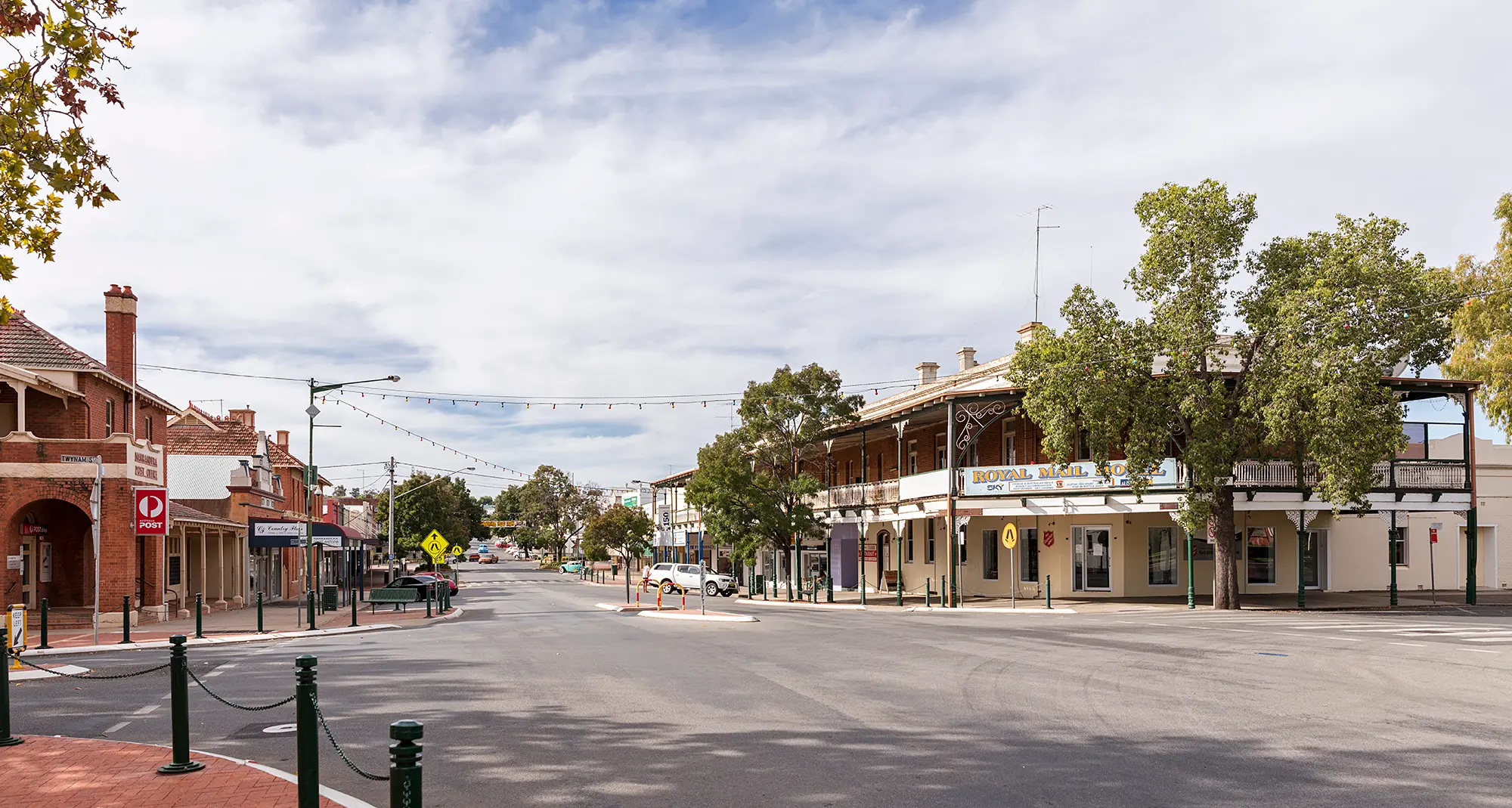
Narrandera had its beginning at Gillenbah, about two kilometres east of the present town, but the floods forced the move to the present site.
Narrandera was the centre of wide pastoral holdings on either side of the river. However after 1861 and selection without survey, selectors began to move into NSW from the south. Narrandera began to grow, catering for the drovers, teamsters and farmers, as well as the employees on the stations.
For a time Narrandera was the most industrialised town in the State, with wharves for the river trade, wool scouring works, sawmills and in 1899 the Wise brothers set up a flourmill. It was not until 1900 that any wheat was shipped away from Narrandera.
At one time Narrandera had the largest Chinese Camp in the country, providing the gangs clearing the timber on the stations and running market gardens.
COMMERCIAL FLOUR MILLS
Riverina alongside the railways at Cootamundra, Junee, Wagga Wagga, Coolamon, Narrandera, Temora and Albury, powered by steam.
At this time the flourmills stood out as the tallest buildings in town. Studying the locations of mill towns on the map, it would seem that the most numerous were north of the Murrumbidgee and become a key to the extent of wheat production after the 1880s.
In the Southern Riverina there was still a considerable concentration of livestock, particularly sheep, in what remained a relatively well-watered district. North of the Murrumbidgee and away from the river flats, and into the less well watered country, but better grain growing soil, wheat was a better proposition.
It was the introduction of the roller mills which William Farrer, the wheat breeder, and F B Guthrie, the Department of Agriculture chemist, could combine the cereal chemistry and the crossbreeding of wheat varieties that revived the wheat industry in Australia.